Prison terms on tap for 'prerelease' pirates

File-swappers who distribute a single copy of a prerelease movie on the Internet can be imprisoned for up to three years, under a bill that's slated to become the most dramatic expansion of online piracy penalties in years.
The bill, approved by Congress on Tuesday, is written so broadly it could make a federal felon of anyone who has even one copy of a film, software program or music file in a shared folder and should have known the copyrighted work had not been commercially released. Stiff fines of up to $250,000 can also be levied. Penalties would apply regardless of whether any downloading took place.
If signed into law, as expected, the bill would significantly lower the bar for online copyright prosecutions. Current law sanctions criminal penalties of up to three years in prison for "the reproduction or distribution of 10 or more copies or phonorecords of one or more copyrighted works, which have a total retail value of $2,500 or more."
Making Music More Enjoyable? Not Allowed!
Among the many clueless things the recording industry has done over the past few years is freak out over people daring to (oh my!) put lyrics online. We've written about a few cases where lyrics sites were forced to shut down due to angry recording industry lawyers, who somehow seem to think that putting up lyrics that make it easier for music fans to enjoy songs is damaging to the industry. It appears that this is still happening, as a bunch of lyrics sites in Germany are being threatened by the recording industry for writing out the lyrics of various songs. It would be interesting to see exactly how the industry thinks they're losing money by having people write out song lyrics online.
Claim to End 99% of Illegal Trading

A Finnish based company called Viralg is predicting the end of unauthorised file sharing.
The company claims their patented "overwrite" technology can mix files on a P2P network, corrupting downloads and rendering them worthless to play.
Unlike current fake file spamming techniques used, Viralg claim their system is effective against those experienced at spotting fake files and even verified file sites.
"We make viable non-working file with a working file hash, so when someone tries to download a working file he/she will receive a random mix of working and non-working file. The final content depends on many things (bandwidth, sources etc.)"
"Simply, we can deliver corrupted content with the same hashcode," the press office informed Slyck.
The technique has not been tested with BitTorrent.
Unintended Consequences of Using GPL Fonts

"An interesting discussion has surfaced on the Scribus mailing list. Simply stated, it appears that using GPL-licensed fonts in a document makes your document subject to the GPL. There are a lot of consequences here, such as internal corporate communications. It appears to make the use of GPL fonts undesirable in almost any document." Yes, it sounds crazy, but the experimental font-exception addition to the GPL (linked from the discussion) lends the idea some credence.
AOL Monitor Accused of Luring 15-Year-Old
An Internet chat room monitor hired to keep children safe from sexual predators seduced a California girl online and was about to meet her for sex when he was found out by a co-worker, a lawsuit charges.
According to documents filed April 1 in Los Angeles Superior Court, the online relationship began when the girl was 15. She met the AOL employee in a children's chat room and confided in him about her parents' divorce and her troubles making friends.
They were preparing to meet on the girl's 17th birthday when one of the monitor's co-workers became suspicious and prevented the encounter.
America Online spokesman Nicholas Graham said the company fired the monitor and contacted authorities after learning of the situation in April 2003. The man, who was 23 when he met the girl online, has not been charged with a crime.
The suit seeks compensatory and punitive damages of more than $25,000 but does not give a specific dollar amount.
George Bush fears email privacy breach

US prez George Bush has admitted he does not send personal emails to daughters Jenna and Barbara for fear that his "personal stuff" might end up in the public domain.
We leave it to readers to imagine quite what exactly any email between George and Jenna and Barbara might contain which - were it released into the wild - could threaten national security*. Bush says it's a personal privacy issue: "I don't want you reading my personal stuff," he admitted, adding: "There has got to be a certain sense of privacy. You know, you're entitled to how I make decisions. And you're entitled to ask questions, which I answer. I don't think you're entitled to be able to read my mail between my daughters and me."
Bush is probably right that people should expect a certain privacy for their personal e-correspondence, in which case he must be delighted by the recently defanged Patriot Act, a typically knee-jerk post-9/11 piece of legislation which attempted to oblige ISPs to "comply with a request for subscriber information and toll billing records information, or electronic communication transactional records".
Short Lifetimes of Optical Drives?
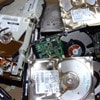
I have various optical disc readers from standard DVD players (apart from a computer), and both CD and DVD readers on one or more computers. My home stereo DVD's have been problematic for a while. One of them won't even take a DVD cleaner disk as it doesn't 'recognize' it as a playable disc, even though it plays discs that my other DVD player won't play. Usually, between the two of them, I can play most discs, but occasionally some discs, purchased new, won't play on either of them.
My internal DVD/CD drive in my desktop can't read either DVD's or CD's. It was about 3 years old. The iomega external was about 2 years old. The laptop internal DVD was about 3-4 years old.
Area 51 secrets unveiled by Google
An enterprising surfer has found a way to harness Google's new mapping facility to uncover the secrets of Area 51.
The American military base, in the Nevada desert, is steeped in history and rumour - allegedly being the place where all of Uncle Sam's work with extra-terrestrials and physics-defying technology takes place. The place is so heavily guarded, it's almost impossible to get within miles of it.
However, with satellite map technology, you can uncover some pretty spectacular pictures of the base, including some interesting structures in and around it that can't quite be identified.
IFPI drafts 'code of conduct' for ISPs
Not content with creating a continent-spanning lawsuit-sharing network using special P2P (person to perpetrator) technology, the record companies' consortium, the International Federation of Phonographic Industries (IFPI) now wants your ISP to sign up to a new "code of conduct" that it has helpfully drafted with the help of the Motion Picture Association (MPA).
Under the new code, ISPs would put in place filtering technology to block services and/or sites that "are substantially dedicated to illegal file sharing or download services". They would retain data beyond what law enforcement agencies require, with the aim of helping track down copyright infringement. They'd hand that data, plus your identity, over to the IFPI or MPA if there was even a complaint - not a court order - against you for, you guessed it, copyright infringement.
According to the draft, the duo want ISPs and network operators to "enforce terms of service that prohibit a subscriber from operating a server, or from consuming excessive amounts of bandwidth where such consumption is a good indicator of infringing activities."
RIAA discovers Internet2
The RIAA said it will today sue over 400 students with access to Internet2, the high speed next-generation network, for copyright infringement. The experimental network is used by universities and researchers and has been demonstrated to transmit a DVD in around 30 seconds.
The sheer speed of I2 makes file sharing much more attractive, exponentially increasing the amount of revenue lost to artists by the RIAA's failure to lobby for a scheme that reimburses them. Similar schemes have been implemented for radio and public broadcast - new technologies that initially robbed artists of their revenue while expanding the potential audience for their creative works. But rather than having the courage to lobby for the traditional reimbursement model to be applied to digital media, the RIAA instead wants the new technology outlawed.
"We cannot let this high-speed network become a zone of lawlessness where the normal rules don't apply," said Cary Sherman, RIAA president.
Quite the contrary. It's the RIAA that has refused to contemplate "the normal rules", and by shunning any prospect of a compulsory license, has denied many millions of dollars of due royalties to its members, royalties those artists rightfully deserve.