Possible Shuttle Mission to Save Hubble

NASA's new Administrator Mike Griffin told reporters today that he informed key members of Congress Thursday evening that he would direct engineers at Goddard Spaceflight center to start preparing for a space shuttle servicing mission to the Hubble Space Telescope on the assumption that one ultimately will go forward.
There is no replacement for Hubble's visible-light acuity even in the serious planning stages.
Griffin said today that a final decision on any possible crewed servicing mission is still pending NASA's successful return to flight with the launch of the shuttle Discovery. However, with that launch now delayed nearly two more months, Griffin said the Goddard team has to get started now to preserve the option of saving Hubble before the popular telescope is scheduled to go dark.
Google redraws world according to George Bush
Here's something quite sinister for armchair conspiracy theorists: it appears that US prez George Bush has final approval on the the UK version of Google Maps and has decided to redesign the world in a way that more adequately reflects his own particular vision.
If you visit http://maps.google.co.uk you'll start off with a map showing the southern part of the UK. Zoom out to maximum distance using the slider on the left, and then pan around to see a unique world view that would warm Dubya's cockles...
That's right. In Google's Brave New World, potential threats to US national security have been neutralised by airbrushing them from the surface of the globe. Naturally, the UK survives the apocalypse by virtue of its "special relationship" with the US.
Rumsfeld demands cash for 'bunker-busting' nuke

US defense secretary Donald Rumsfeld yesterday asked Congress to agree $8.5m of funding for research into a ground-penetrating nuclear weapon which would address what Rumsfeld considers the growing problem of potential enemies burying vital installations deep underground. Last November, Congress pulled the plug on $27m earmarked for a study into the "Robust Nuclear Earth Penetrator", Reuters reports.
Rumsfeld was at pains to point out that Pentagon wants the cash purely for research - not to build an actual weapon. He said: "The only thing we have is very large, very dirty, big nuclear weapons," adding: "It seems to me studying it [the RNEP] makes all the sense in the world."
California Democratic Senator, Dianne Feinstein, countered: "It is beyond me as to why you're proceeding with this program when the laws of physics won't allow a missile to be driven deeply enough to prevent deadly radioactive fallout from spewing into the air after a nuclear detonation."
Rumsfeld reported that the Pentagon estimates 70 countries are currently constructing subterranean facilties beyond the reach of the US's nuclear arsenal. Quite how it arrived at this figure is unclear.
Microsoft Demands Removal Of Longhorn Images

After the previously reported release of the Longhorn beta at this year's WinHEC, Neowin and other Windows sites are reporting that Microsoft is going around sending legal letters demanding removal of Longhorn Build 5048 screenshots. Paul Thurrott discusses it on his site, stating that Microsoft never told anyone beforehand not to post screenshots of the publicly available beta, and links to the new galleries he has up now. 'Enjoy it while it lasts.'
Hybrid flash-magnetic drive
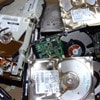
MS and Samsung have jointly developed a hybrid hard drive (HHD) that uses a 1Gbit NAND flash memory as a read and write buffer. The drive caches data in the flash memory so that it can stop spinning for long periods of time, as the computer reads and writes to the flash instead of to the disk. When the drive isn't spinning, it uses less power, so this technology will be attractive for mobile hard drives. There's no word in any of the articles I've seen so far as to how flash memory's erasure endurance issues are addressed, if at all. From what I've read, NAND flash is good only for from 100,000 to 1 million writes, which doesn't seem like a lot to me if it's being used as a hard drive replacement.
I wonder about the possibility of making the flash buffer visible to applications, like Photoshop, for instance. It's possible that the OS could allow a certain amount of user-level and application-level management of the flash space, especially as that space grows bigger with drops in flash prices.
French court bans DRM for DVDs

A French appeal court just issued a ruling preventing the inclusion of anti-copying measure on DVD. This is after a man who was not able to copy a DVD he purchase to a VHS cassette so he can watch it at his mother's place. Which is considered private copying and is a consumer right in France. He got the help of a consumer protection group to sue the Film Studio that produced the DVD. Film studios have one month to unprotect DVDs (I assume it is not for DVD that you already own).
Enforcing Crytographically Strong Passwords

The WebAppSec mailing list at SecurityFocus is currently having an interesting discussion on how to force users to use cryptographically strong passwords. The original poster suggested displaying a list of randomly generated password for the user to choose from. Two issues pointed with this concept, were Shoulder surfing and the fact that a bunch of randomly generated passwords are hard to remember. A counter proposal was to use pronounceable but randomly generated password. A full summary of this discussion is available.
Police Payoff Probe
Two NYPD veterans are being investigated by Internal Affairs for allegedly accepting payoffs from the motion-picture industry to arrest vendors of pirated DVDs, law-enforcement sources told The Post.
Often they would act on tips from investigators with the Motion Picture Association of America, many of whom are former cops, sources said.
There is nothing improper about that practice. But on at least four occasions in Brooklyn, Manhattan and Staten Island, the task force officers arrested the vendors, confiscated the illegal movies and then allegedly received gratuities of several hundred dollars from the MPAA itself or its investigators, the source said.
Virus pits itself against music pirates

A hacker has created a virus that targets music lovers by deleting MP3 files on infected computers, according to antivirus company Sophos.
Nopir.B is designed to look like a DVD-cracking program, to fool people looking for a program that will circumvent copy-restriction technology on the discs. When the worm is downloaded and run, it attempts to delete all MP3 music files and wipe some programs from the infected PC, the company said in its advisory.
"The Nopir.B worm targets people it believes may be involved in piracy, but fails to discriminate between the true criminals and those who may have legally obtained MP3 files," Graham Cluley, senior technology consultant for Sophos, said in a statement. "Whichever side of the fence you come down on in regards to Internet piracy, there's no debate about the criminal nature of this worm--it's designed to inflict malicious damage on people's Windows computers."
You're going to be taxed for music and love it!
Long before Napster existed, the music industry condemned itself to a broken sales model. It guaranteed piracy, huge online song swaps and declining revenue. Luckily, none of this has much to do with the health of music. Music is thriving like never before. It's the moguls and not the musicians who are hurting.
The record labels have gotten off pretty light in the P2P debate by making curious children seem like immoral thugs destined for a life of crime. Downloading that U2 song is the first step toward shoplifting and eventually clubbing grandmothers. It's easy to forget the CD price-fixing, scandalous use of sex, drugs and violence as promotional tools and total disregard for the technology landscape as drivers of the record labels' own failure.
Today, the artist gets 8 percent of the average CD sale with the label taking 49 percent, the retailer taking 30 percent, manufacturing taking 8 percent and shipping taking 5 percent.
Instead of looking at P2P users as dissatisfied, disgruntled customers and trying to make life better for them, the record labels saw criminals harming their bottom line. They chose to sue their customers and to lock down already digitized and wild music. The Future of Music explains why this was the worst of all possible reactions and why the record labels simply can't win this fight.