Rights issue 'delays Hobbit film'

Oscar-winning director Peter Jackson cannot film The Hobbit until legal problems are resolved between two movie studios, he said.
Jackson said that while New Line Cinema owns the rights to make the Lord of the Rings prequel, MGM has the rights to distribute it.
"Their lawyers are going to have a huge amount of fun over the next few years trying to work it all out," he said.
Jackson added that if he directed the Hobbit, he would like it to fit in with his Lord of the Rings film trilogy.
"I'd want Ian McKellen to be back as Gandalf, I'd want it to feel like it was part of the same mythology that we've done with Lord of the Rings."
Gates: Buy stamps to send e-mail

NEW YORK (AP) -- If the U.S. Postal Service delivered mail for free, our mailboxes would surely runneth over with more credit-card offers, sweepstakes entries, and supermarket fliers. That's why we get so much junk e-mail: It's essentially free to send. So Microsoft Corp. chairman Bill Gates, among others, is now suggesting that we start buying "stamps" for e-mail.
Many Internet analysts worry, though, that turning e-mail into an economic commodity would undermine its value in democratizing communication. But let's start with the math: At perhaps a penny or less per item, e-mail postage wouldn't significantly dent the pocketbooks of people who send only a few messages a day. Not so for spammers who mail millions at a time.
Goodmail chief executive Richard Gingras said individuals might get to send a limited number for free, while mailing lists and nonprofit organizations might get price breaks.
Microsoft develops system to record your life
Software firm Microsoft has developed a visual diary, which is designed to be worn around the neck, and takes up to 2,000 images a 12-hour day. These images can be downloaded onto a PC and reviewed when needed.
Dubbed SenseCam, the prototype takes a snap whenever there is a drastic change in scenery. Boffins at Redmond want it to respond to other stimuli such as heart rate or skin temperature to track medical problems.
One day it could eventually link with other technology, such as face recognition to remind wearers when they have seen someone before.
Currently those using the prototype are using it to find where they left their car keys or interesting clothes they saw in a shop.
Shocking Way to Transform Waste
For the first time, a microbial fuel cell has generated electricity while cleaning wastewater, a development that could make sewage treatment more affordable for both industrialized and developing nations, researchers said.
The prototype fuel cell, developed at Pennsylvania State University with support from an $87,000 National Science Foundation grant, is described in the next issue of the journal Environmental Science & Technology (subscription required).
The article reports that the fuel cell removed up to 78 percent of organic matter from the water and produced between 10 and 50 milliwatts of power per square meter of electrode surface. Since the paper's submission, the cell has produced up to 200 milliwatts per square meter -- enough to power a small light bulb, said Bruce Logan, the Penn State professor of environmental engineering who directed the project.
While a typical fuel cell runs on hydrogen, a microbial fuel cell relies on bacteria to metabolize food, releasing electrons that yield a steady electrical current. Other microbial fuel cells have used fuels like glucose or ethanol. In this case, the fuel was skimmed from the settling pond of a wastewater treatment plant.
SCO prepped lawsuit against BofA
The SCO Group filed lawsuits this week against DaimlerChrysler and AutoZone, but the Unix seller's attorneys also had prepared a complaint against Bank of America, according to a document.
A Microsoft Word document of SCO's suit against DaimlerChrysler, seen by CNET News.com, originally identified Bank of America as the defendant instead of the automaker. This revision and others in the document can be seen through powerful but often forgotten features in Microsoft Word known as invisible electronic ink.
A feature in the word-processing software tracks changes to documents, who made those changes, and when they were made. These notations typically are invisible to someone reading a Word document. But as some lawyers, businesspeople and politicians have learned the hard way, Word can also display so-called metadata in the document--including the original version and all subsequent changes. This information is available by viewing the document under "original showing markup" or "final showing markup."
Researchers developing robotic exoskeleton
BERKELEY – The mere thought of hauling a 70-pound pack across miles of rugged terrain or up 50 flights of stairs is enough to evoke a grimace in even the burliest individuals. But breakthrough robotics research at the University of California, Berkeley, could soon bring welcome relief — a self-powered exoskeleton to effectively take the load off people's backs.
The Berkeley Lower Extremity Exoskeleton (BLEEX), as it's officially called, consists of mechanical metal leg braces that are connected rigidly to the user at the feet, and, in order to prevent abrasion, more compliantly elsewhere. The device includes a power unit and a backpack-like frame used to carry a large load.
The engineers point out that while the exoskeleton does the heavy lifting, the human contributes to the balance. "The pilot is not 'driving' the exoskeleton," said Kazerooni. "Instead, the control algorithms in the computer are constantly calculating how to move the exoskeleton so that it moves in concert with the human."
Hubble Captures a Starry Night
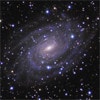
Vincent Van Gogh saw the night sky as nobody else did -- until now. New images from the Hubble Space Telescope show an expanding swirl of illuminated interstellar dust reminiscent of the painterly skyscape of Van Gogh's "Starry Night."
The images captured in early February depict a distant red giant star called V838 Monocerotis, located about 20,000 light-years from Earth. The star gave off a pulse of light that illuminated a turbulent cloud of dust and gas, says NASA, revealing the swirls and eddies shown in the pictures at left.
While V838 Monocerotis is similar to a nova in many ways, it is unique among observed stellar objects for its behavior and its intense red color, according to the space agency.
The expanding light from the star will continue to illuminate more distant dust clouds, changing their appearance as it does. The object will be visible at least through 2010, say astronomers.
File-swap 'killer' grabs attention

A new political battle is brewing over Net music swapping, focusing on a company that claims to be able to automatically identify copyrighted songs on networks like Kazaa and to block illegal downloads.
The company's main demonstration for the last several weeks has been a version built into a piece of open-source Gnutella software. Similarly, it could be built into any other popular file-swapping package, company CEO Ikezoye said.
In that software-based version, the technology watches what songs are being downloaded, and when it has enough data to make a match--usually about a third to half of the file--it uses the Net connection to call Audible Magic's database. If it finds a match with a copyrighted song, it stops the download midstream.
Audible Magic's technology is far from perfect, even if it works as demonstrated. It's most critical weakness is likely to be encrypted files and encrypted networks, which its audio recognition software can't break through. Nor is it difficult to imagine hackers creating "cracked" versions of file-swapping software that have the song-recognition technology broken or stripped out, if legislators were to mandate its use.
Network Associates patents file deletion
Network Associates is proudly telling the world about a new patent they've been granted by the US Patent and Trademarks Office (USPTO).
The patent goes on to describe such revolutionary techniques as: Automated upgrades of software that needs upgrading and even: Performing diagnostics on the computer.
We at the INQUIRER would like to contgratulate Network Associates on their excellent invention. They will clearly want to make good use of the patent. As a first step, might we recommend suing Microsoft for their windowsupdate.microsoft.com website, which is clearly in blatant violation of the patent, filed October 4, 2002?
All this adds extra urgency to the need for US-style software patents here in Europe. Clearly, innovation is being stifled on a huge scale when groundbreaking inventions like "generating a report including a graph that is based on a statistical analysis" are denied the protection of a state-enforced monopoly.
US tells China to get off its wi-fi case

The US government has sent a stiff note to the dictators in China telling them not to stop the importation of wireless equipment.
The letter, from Colin Powell, commerce secretary Don Evans and trade rep Robert Zoellick follows howling from US high tech companies which have complained about Chinese plans to make imports conform to its own home grown encryption standards.
The WSJ reports that the letter is the latest move in trade skirmishes between the US and China. China has rules which may breach World Trade Organisation (WTO) rules on free trade.
The Chinese government has a number of tweaks to WTO rules that cause foreign countries to pass through a series of import hoops.
The Journal says the US trade deficit with China currently amounts to a staggering $124 billion.