eXeem Lite Public Beta Released

Just days after the release of eXeem Open Beta comes eXeem lite 0.19 Public Beta. Much like with KaZaA, the official version of eXeem comes chock full of spy/adware -- specifically, cydoor. eXeem lite is spyware free and free of bloat -- and free. Version .20, which should fix a few minor bugs, is expected 'in next coming days.' (read: soon)
Verizon faces lawsuit over email blocking

Aggrieved Verizon customers are invited to join a class action that seeks damages arising from the US ISP's enthusiastic email filtering policies. Philadelphia law firm Kohn, Swift & Graf, P.C. filed suit this week against Verizon on behalf of a DSL subscriber in a civil case that seeks class action status.
Since 22 December, mail servers at verizon.net have been configured to reject connections from Europe and other parts of the world including China and New Zealand by default, according to Reg readers and industry sources such as MessageLabs.
John Vincenzo, a spokesman for Verizon, told us that the "vast majority" of Verizon's 4m dial-up and DSL customers are happy with its "long standing" policy on spam and virus filtering. He conceded that some otherwise legitimate email has been blocked but gave no indication that Verizon has any plans to review its policy.
According to Vincenzo, spam complaints come from spammers themselves.
Is IRC All Bad?
"IRC is often portrayed by the media as a haven for illegal activity. The author of IRC Hacks set out to find whether or not this was true. His conclusions are quite alarming, suggesting that 99.9% of IRC usage is illegal although he backs up IRC by saying that it is also used for lots of constructive purposes and is used by open source software developers." Update: 01/21 05:17 GMT by P: The author claimed it was merely 99.9% of traffic "to the top 60 channels" that is illegal, not 99.9% of all IRC traffic.
Think Secret Gets Lawyer

Looks like Nick dePlume and ThinkSecret have gotten some much needed help for their upcoming lawsuit battle with Apple. "Terry Gross of Gross & Belsky LLP, a lawyer at the forefront of Internet law since the net's early days, will defend Mac news Web site Think Secret from a lawsuit brought by Apple Computer Inc. 'Apple's attempt to silence a small publication's news reporting presents a troubling affront to the protections of the First Amendment,' said Nick dePlume, the site's publisher and editor in chief. 'I'm grateful that Mr. Gross has stepped forward to help defend these crucial freedoms.'"
Mystery compound in beer fights cancer

Some cancers are caused by heterocyclic amines, DNA-damaging chemicals found in cooked meat and fish. When Sakae Arimoto-Kobayashi's team at Okayama University in Japan fed these chemicals to mice, the DNA damage to their liver, lungs and kidneys was reduced by up to 85% if the mice drank non-alcoholic beer instead of water.
Heavy alcohol consumption is blamed for around 6% of all cancers in western countries (New Scientist print edition, 18 December 2004), though moderate consumption reduces the risk of heart disease. Since the mice drank non-alcoholic beer, the findings do not show whether moderate consumption of normal beer has any anti-cancer benefits.
Plastics made from oranges
A Cornell University research group has made a sweet and environmentally beneficial discovery -- how to make plastics from citrus fruits, such as oranges, and carbon dioxide. In a paper published in a recent issue of the Journal of the American Chemical Society (Sept. 2004), Geoffrey Coates, a Cornell professor of chemistry and chemical biology, and his graduate students Chris Byrne and Scott Allen describe a way to make polymers using limonene oxide and carbon dioxide, with the help of a novel "helper molecule" -- a catalyst developed in the researchers' laboratory.
By using their catalyst to combine the limonene oxide and CO2, the Coates group produced a novel polymer -- called polylimonene carbonate -- that has many of the characteristics of polystyrene, a petroleum-based plastic currently used to make many disposable plastic products.
The Coates research team is particularly interested in using CO2 as an alternative building block for polymers. Instead of being pumped into the atmosphere as a waste product, CO2 could be isolated for use in producing plastics, such as polylimonene carbonate.
Wireless USB Hooks up USB Flash Drives
We never expected this, but two of our favorite technologies – P2P and Wireless USB are about to rolled into one device thanks to Memsen’s Click n' Share keychains. While providing the essential function of storing files as a USB flash drive, when two of these come within range of each other, wireless file sharing can take place between the two drives without any computer intervention. The keychains are also capable of interacting and downloading files such as product brochures from what Memsen calls the DataVendor, a Wireless USB enabled advertising display.
Memsen is currently deciding between Jabil Circuit and Steve Wozniak’s Wheels of Zeus to produce the platform, which will be used in closed testing and convention centers.
Peer-to-peer 'seeders' could be targeted
BayTSP, based in California, US, monitors peer-to-peer (P2P) trading networks using a technique called software "spidering". The new software, called FirstSource, allows it to determine which user first uploaded a particular file for trading. It does this by mimicking the behaviour of a user on a massive scale - sending out multiple requests for a file extremely quickly. It deduces the culprits by assuming that only they will have the full 100% of the file, having uploaded the original.
Graham says FirstSource could enable copyright enforcers to focus their legal attacks against those who are at the root of illegal distribution.
Adam Langley, a UK-based P2P programmer adds that network developers could also modify their software to get around such monitoring.
"I suspect it would only require a trivial modification to render this technique useless," adds Ian Clarke, who is one of the programmers behind an anonymous file-trading network called Freenet. Freenet makes it impossible to tell who requests a file by encrypting data and communications and distributing between multiple sources.
Verizon persists with European email blockade
US ISP Verizon is persisting with a controversial policy of blocking email sent from Europe. Since 22 December, mail servers at verizon.net have been configured not to accept connections from Europe by default.
Verizon is blocking ranges of IP addresses belonging to British and European ISPs (the IP space from RIPE, APNIC, and more) in a misguided attempt to reduce spam. Domains are only unblocked following complaints, with Europeans effectively treated as guilty till proven innocent.
Verizon media relations manager Ells Edwards told Wired that he didn't know when the ISP would lift its blockade. "Normally these things abate in a matter of days," Edwards said.
Verizon three million DSL customers waiting for emails from Europe were advised to use alternative forms of communication. "If it's really important you might want to make a phone call," he said.
Disk drives to stop shrinking
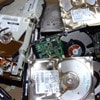
While consumers have gone bonkers for music players and other sleek devices sporting tiny hard drives, disk drive companies say there's little room, and even less desire, for further reducing the size of the drive platters--the silver disks that spin around and hold data.
The problem goes back to Archimedes and some basic science. Reducing the diameter of a drive platter greatly reduces the surface area for storing data. And less available storage space makes it more difficult for drives to distinguish themselves against flash memory. Typically, flash memory accesses data faster, but drives can provide far greater storage capacity for the same amount of money.
Brzeski, Healy and several analysts predict that drive makers will be able to maintain an advantage over flash when it comes to large-capacity devices. When 10GB mini drives hit the market next year, 10GB of flash memory might cost 10 times as much, Porter speculated.