NSA Whistleblower Alleges Illegal Spying

Russell Tice, a longtime insider at the National Security Agency, is now a whistleblower the agency would like to keep quiet.
For 20 years, Tice worked in the shadows as he helped the United States spy on other people's conversations around the world.
Tice says the technology exists to track and sort through every domestic and international phone call as they are switched through centers, such as one in New York, and to search for key words or phrases that a terrorist might use.
"If you picked the word 'jihad' out of a conversation," Tice said, "the technology exists that you focus in on that conversation, and you pull it out of the system for processing."
President Bush has admitted that he gave orders that allowed the NSA to eavesdrop on a small number of Americans without the usual requisite warrants.
But Tice disagrees. He says the number of Americans subject to eavesdropping by the NSA could be in the millions if the full range of secret NSA programs is used.
Spin Doctors Create Quantum Chip

University of Michigan scientists have created the first quantum microchip, which could be a giant stride in the race to produce a new generation of brawny, super-fast computers.
So, on a semiconductor chip roughly the size of a postage stamp, the Michigan scientists designed and built a device known as an ion trap, which allowed them to isolate individual charged atoms and manipulate their quantum states.
Known as quantum superposition, the ability of the qubit to occupy two quantum states at once means that it can execute computations at an exponentially faster rate. Each time a qubit is added to a quantum system, its computing power doubles.
Will your notebook or desktop PC someday sport quantum innards? It's unlikely, at least in the immediate future. Researchers believe quantum systems will be much more efficient at rock-solid cryptography and mass database searches than running the latest version of Doom.
Chinese ban on Wikipedia prevents research

Chinese students and intellectuals are expressing outrage at Beijing's decision to prohibit access to Wikipedia, the fast-growing on-line encyclopedia that has become a basic resource for many in China.
Wikipedia, which offers more than 2.2 million articles in 100 languages, has emerged as an important source of scholarly knowledge in China and many other countries. But its stubborn neutrality and independence on political issues such as Tibet and Taiwan has repeatedly drawn the wrath of the Communist authorities.
The latest blocking of the website, the third shutdown of the site in China in the past two years, has now continued for more than 10 weeks without any explanation and without any indication whether the ban is temporary or permanent.
Chinese authorities twice blocked the Wikipedia website for several weeks in 2004, apparently because it included articles on banned subjects such as the Taiwanese independence movement, the Tibetan autonomy issue and the Tiananmen Square student protests that were crushed by the Chinese military in 1989.
Trolling Is Now Illegal: Two Years In Jail

Why do we still let our government attach totally unrelated bills to each other to sneak in terribly written laws? It seems to keep happening, and the latest one is that a bill attached to a bigger bill concerning funding the Department of Justice (something very few politicians would ever vote against) has a tiny bit of language that now means if you're anonymously annoying online, you face two years in jail. The specific text says that using the internet "without disclosing his identity and with intent to annoy... shall be fined under title 18 or imprisoned not more than two years, or both." Yes. "Intent to annoy" seems like an incredibly vague standard and has basically criminalized an awful lot of the internet -- including quite a few of the folks who comment here at Techdirt. Anyway, for those of you who enjoy anonymously trolling all over the place online -- watch out. You may face jailtime. Of course, it seems quite unlikely that "intent to annoy" would hold up under Constitutional review, but it may be some time until that test case comes.
DRM kills award chances for Munich
Since opening last month, Steven Spielberg's Munich has been touted as a possible Oscar contender. Hopefully for Spielberg, the Academy of Motion Picture Arts and Sciences will actually be able to watch a copy of the movie before having to vote. The British Film Academy (BAFTA) couldn't, thanks to a DVD mastering screw-up.
All 5,000+ BAFTA members were to be given copies of Spielberg's latest for consideration. However, due to a customs screw-up, the DVDs weren't distributed in time for the first round voting deadline. After getting the customs snafu fixed, the DVDs were finally sent out to the BAFTA screeners. Problem solved, right?
Wrong. The DVDs were encoded for Region 1 (US and Canada), not Region 2 (most of Europe). As a result, only those who had seen Munich in the theaters were able to vote on it.
Making DVDs unplayable outside of arbitrary, industry-defined geographical regions was one of the more nonsensical decisions made by the movie studios. The studios wanted the region encoding to protect revenues from staggered releases of both theatrical and DVD releases and as an antipiracy measure. However, it has the added bonus effect of allowing them to control pricing in different parts of the world.
Computers That Feel our Mood
It certainly happened to you to be so frustrated by the 'reactions' of your computer that you wanted to break it. And the computer industry has noticed, trying to build hardware and software as user-friendly as possible. Still, it would be a good idea for your computer to guess when you're about to become mad at it. Researchers at the Fraunhofer Institute in Germany are working on computers that estimate our emotions. Their solution involves cameras and image analysis, but also special gloves equipped with sensors to record your heartbeat and breathing rate, your blood pressure or your skin temperature. And even if it's difficult to train a computer to interpret emotions, they have enough confidence in their system to demonstrate it at the next CeBIT in March 2006.
Shop assistant found naked with mannequin

A Turkish shop assistant was arrested after he was found lying naked with a mannequin in a store window.
The 30-year-old man was discovered by colleagues opening up the department store in Antalya for the day.
They called police after noticing bite marks on the mannequin. Two other mannequins that showed signs of abuse were also taken in as evidence.
Students concoct music industry's nightmare

A group of students at the Viktoria Institute in Gothenburg, Sweden, has worked out a system of P2P music listening and sharing that will make the head of the RIAA wake up in the night in a cold sweat.
The students have developed something they call Push!Music. This is a mobile, peer-to-peer music listening and sharing application.
It runs on WiFi-enabled PDAs and allows users to actively recommend songs by pushing music to other users in the proximity.
You might be walking down the street and a complete stranger, who happens to have the same music taste as you stored on his PDA, might send you some tracks that his machine knows you are missing.
Meanwhile you would be opening your entire music collection to everyone within wi-fi range to borrow.
OEM Hard Drive With Window
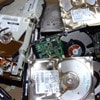
At last, you don't need to mess around with Dremel tools and Lexan (and destroy your valuable data) to get a clear window in your hard drive. Western Digital has released the Raptor X 150GB SATA hard drive. 10,000 RPM, 4.6ms seek time, 16MB buffer, and, yes, a clear window so you can see what's going on inside. Made out of a special polycarbonate lens with an ESD-dissipative coating, the lens is designed to let case modders and their groupies see the drive platters and heads without sacrificing data integrity.
Paper Trails And Source Code Needed

It looks like folks in Wisconsin have been paying attention to the problems found in many e-voting systems. The Governor there has signed into law a requirement that all e-voting machines include a verifiable paper trail that would let a voter check his or her vote before leaving the booth -- and which can be used for an official recount, if necessary. Perhaps more interesting, though almost entirely ignored by most press accounts of this new law, is a separate claim that this law not only requires e-voting providers to hand over their source code (similar to other states), but that the companies need to make that source code "publicly accessible" so that it "may be used to independently verify the accuracy and reliability of the operating and tallying procedures to be employed at any election." This is a big step forward that, hopefully, other states will emulate.