Mexico boy tries to stick at home

A Mexican boy glued his hand to his bed because he did not want to go back to school after the Christmas break.
His mother Sandra found him watching television with his hand stuck to the bedstead. "I don't know why he did it," she said. "He is a good boy."
Police and paramedics eventually managed to free him unharmed, and he was only a few hours late for school.
Diego had got up early to fetch some industrial-strength glue from the kitchen.
2007 worst ever year for data protection

Last year was the worst ever for data losses in the UK, with almost 37 million people having their private data compromised.
The government's loss of 25 million child benefit records was the largest single screw-up, but other government departments and private companies played their part too.
"There is simply no way that any democratic government can expect an unwilling public to accept having their precious personal data cropped and stored in the world's largest database when they aren't confident that database will be safe."
In total, 36,989,300 people in the UK have had their private records compromised.
New Boeing 787 vulnerable to hacking

According to to the U.S. Federal Aviation Administration, the new Boeing 787 Dreamliner aeroplane may have a serious security vulnerability in its on-board computer networks that could allow passengers to access the plane's control systems.
The computer network for the Dreamliner's passengers, designed to give passengers in-flight internet access and entertainment, is connected to the plane's control, navigation and communication systems, the FAA report reveals.
More worryingly, there seems to be some confusion at Boeing as to what exactly the situation is, as Boeing spokeswoman Lori Gunter said the wording of the FAA document is misleading, and that the plane's networks don't completely connect. Why are you testing a new solution then?
Sony BMG Plans to Drop DRM
The last major label will throw in the towel on digital rights management and prepare to fight Apple for valuable download revenues
In a move that would mark the end of a digital music era, Sony BMG Music Entertainment is finalizing plans to sell songs without the copyright protection software that has long restricted the use of music downloaded from the Internet, BusinessWeek.com has learned.
Labels used DRM software in an effort to prevent illegal sharing of songs on peer-to-peer networks, such as Gnutella. Instead, the restrictions served mainly to frustrate paying customers, forcing them to degrade the quality of music by first burning it to a CD before uploading it for play on the device of their choosing.
Bad COPP No Netflix
Hollywood isn't quite as thrilled about my new HD Media Dream Machine and they've decided to punish me by revoking my Watch Now privileges from Netflix.
The minute I saw "this will potentially remove playback licenses from your computer, including those from companies other than Netflix or Microsoft" I knew better than to hit continue.
In order to access the Watch Now service, I had to give Microsoft's DRM sniffing program access to all of the files on my hard drive. If the software found any non-Netflix video files, it would revoke my rights to the content and invalidate the DRM. This means that I would lose all the movies that I've purchased from Amazon's Unbox, just to troubleshoot the issue.
Because my computer allows me to send an unrestricted HDTV feed to my monitor, Hollywood has decided to revoke my ability to stream 480 resolution video files from Netflix.
The irony in all of this, is that the DRM that Hollywood is so much in love with, is really only harming their paying customers. When you do a DRM reset, it's not your pirated files that get revoked, it's the ones that you already paid for that are at risk.
It's as if the studios want their digital strategies to fail.
Washington Post sticks by RIAA
Marc Fisher, a Post columnist, wrote on Sunday that the Recording Industry Association of America (RIAA) asserted in a legal brief that anyone who copies music from a CD onto their computer is a thief. The document, filed last month, was part of the RIAA's copyright suit against Jeffrey Howell, an Arizona resident accused of illegal file sharing.
The problem with Fisher's story is that nowhere in the RIAA's brief does the group call someone a criminal for simply copying music to a computer. Throughout the 21-page brief, the recording industry defines what it considers to be illegal behavior and it boils down to this: creating digital recordings from CDs and then uploading them to file-sharing networks.
German privacy activists cry foul

Privacy activists have filed a constitutional complaint against Germany's data retention laws.
Arbeitskreis Vorratsdatenspeicherung argues that the data retention law treats all citizens as potential terrorists or delinquents. "The pervasive logging of communication patterns without reasonable suspicion resembled a serious encroachment upon the basic values of constitutional legality," it said.
Organisations and individuals that rely on confidentiality to do their work - lawyers, journalists and even crisis lines - are deprived of free and open communication because of the data logging, the group claims.
Governments across Europe brought in the measures, which backers argue are necessary in the fight against terrorism and organised crime.
Storage Projects Rise in Importance
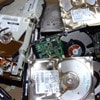
In 2008, almost every sector will continue the battle with data overload. Entertainment powerhouses - from television stations to big-name amusement parks - will struggle to house huge media files or to manage the data necessary to track customer spending trends.
According to Milford, Mass.-based analyst firm Enterprise Strategy Group Inc., private-sector archive capacity will hit an eye-popping 27,000 petabytes by 2010. Skyrocketing rates of e-mail growth account for much of this figure.
To combat spiraling data overload, corporate IT leaders will scour the market for ways to centralize storage and they will pursue options such as clustered architectures and unified storage-area networks (SAN). Data-pruning techniques, including the use of thin provisioning and data de-duplication tools, will also be high on 2008 corporate storage wish lists, according to Forrester Research Inc. analyst Andrew Reichman.
Dial-Tone Phreak
This was in the early 1950s. He was still Josef Engressia then, born in Richmond, Va., and phones were solid objects.
"Lots of scary sounds and stuff at night," he'd say, years later. "Sometimes I'd hug my phone up close and listen to the dial tone, the soft hum of the dial tone that was always there."
At 7, with his perfectly pitched ear, he heard through the receiver the tone that controlled long-distance connections, 2,600 cycles per second. "I started whistling along with it," he said, "and all of a sudden the circuit cut off, and I did it again, and it cut off again. And gradually... I figured out - back in the mid-'50s - just how to do it."
In 1971, Ron Rosenbaum, in his landmark Esquire article, called him "the original granddaddy phone phreak," though he was only 22.
Children love telephones. Joybubbles, who was 5 years old when he died this year, and 5 years old the year before that, 5 years old for almost 20 years, was no exception.
When Joybubbles died, Steven Gibb arranged a telephone memorial, a sort of Quaker service over phone lines, a conference call four hours long with 50 people telling stories.
Record Industry Goes After Personal Use
In legal documents in its federal case against Jeffrey Howell, a Scottsdale, Ariz., man who kept a collection of about 2,000 music recordings on his personal computer, the industry maintains that it is illegal for someone who has legally purchased a CD to transfer that music into his computer.
The industry's lawyer in the case, Ira Schwartz, argues in a brief filed earlier this month that the MP3 files Howell made on his computer from legally bought CDs are "unauthorized copies" of copyrighted recordings.
At the Thomas trial in Minnesota, Sony BMG's chief of litigation, Jennifer Pariser, testified that "when an individual makes a copy of a song for himself, I suppose we can say he stole a song." Copying a song you bought is "a nice way of saying 'steals just one copy,'" she said.
The RIAA's legal crusade against its customers is a classic example of an old media company clinging to a business model that has collapsed.